We created a shoot board so that we could stay organised on the shoot, and to make sure that we wouldn't miss any shots that we had planned to take.
We created our shoot board set-up by set-up, as well as based on the times our actors and make-up artist were available. This meant we needed to include our call time for all the people who needed to be there.
Here is a presentation of our shoot board pages in order.
PROS OF MAKING A SHOOT BOARD:
Helps us to stay organised on the shoot.
Ensures that we take all of the shots that we need in the amount of time we have.
Allows us to set up the studio in advance and tell people when they need to be there.
We decided that we should do rehearsals for some of our shots because some of the scenes involved dances and movement sequences that were complicated for us to do considering none of us have any dancing experience. The biggest challenge was choreographing the movements for Singin in the Rain and Mortal Kombat. The dances for Singin in the Rain were difficult because we needed to keep the framing tight while also doing big dances with umbrellas around a lamp post. This meant that we often went off frame even when we did get the movements right. Additionally, it was difficult to use the umbrellas gracefully in the dances, so we really had t practise that. The Mortal Kombat movements were quite difficult to get nicely on frame, as the power bars were difficult for jack and Lily (our make-up artist) to manoeuvre smoothly, and to keep their bodies off frame. We also rehearsed the fight sequence Emilio and I were to do so that it would be clear in the narrative for the audience and also look smooth on camera.
Emilio and I rehearsing our fight scene during the test shoot.
BENEFITS OF REHEARSING:
Saved us lots of time in the actual shoot, as we already knew what we had to do and how.
Got us performance-ready, so that we were used to our characters and how to act as a part of a band.
Allowed us to make sure that our dances looked neat and professional.
For our shoot, we were lucky enough to have access to our school's professional standard equipment, including a Canon 5D camera, which enabled us to produce high quality footage, taking in the detail of all the lighting, costumes, props beautifully. It also had a manual focus lens, which allowed us to tamper with the depth of focus, and allowed us to get really nice crisp shots.
The lighting desk was really useful because it allowed us to create full-colour lighting set-ups with different colour mixes and light intensities depending on the scenes. For example, for the Singin in the Rain shots we used mix of yellow and red lighting at a low intensity so that the camera could pick up the lights on the lamppost as well as having our faces well-lit.
The sound desk was also a very useful piece of kit because it allowed us to play the song while performing, which helped with our performance standard and definitely with my lip-syncing. Also, it meant that when we were setting up and packing away the kit, we could listen to music on the speakers.
The Samsung TV monitor and the Koolertron monitor were both incredibly useful as well. The Koolertron monitor made it really easy to see the screen and test how the lighting set-ups looked like on the camera, as the built in digital screen on the camera was too small to be able to accurately focus and see the footage quality. The Samsung TV monitor was useful because we could see it when we were performing, helping us to stay in frame when and make sue our performance was up to standard, and it also meant that when creating the lighting set-up, we could see how the colours looked on screen from the lighting desk (although it is not as accurate as the Koolertron monitor in terms of colour).
We chose to use Emilio, Jack, and me as the band members, as well as Tom Brown, who did media AS with us last year. This is because we all have similar free periods, and we know we are all going to be dedicated to the shoot and our performances.
Me as Casey Tyler.
Casey Tyler - We cast me as Casey Tyler because she is an energetic character, and it is much easier having a group member as the lead. Additionally, I have been involved with drama things in the past, so I am a confident performer. We decided to make a screen test in order to make sure I matched the role of the lead singer.
This is our screen test. We thought that my lip syncing matched the voice, and that with a bit of extra training i can portray Casey's character well.
Jack as Hugh Tyler.
Hugh Tyler - We cast Jack as Hugh Tyler because he is the second most important in the band, and we are confident in Jack's performance skills as he does A2 drama and is always amazing in the school production. Additionally, we wanted to show Casey and Hugh as having close, friendly relationship, and this would be easy for Jack and me to pull off as we have been close friends for years. Jack was also the bass player in the music video remake task, so he has had practise in playing the guitar to the music convincingly.
Tom as Terrence Kitchener.
Terrence Kitchener - We cast Tom Brown as Terrence because he is an ex-media student, so we know he will take the role very seriously, and he plays the piano, so can play the keyboard convincingly in the video. We also tested to see how he would be playing the keyboard in character, and he was very confident, and pulled off Terrence's smug expressions extremely well.
Emilio as Guy Chapman.
Guy Chapman - We cast Emilio as Guy because he has had experience performing in the music video remake prelim, and also has a drum kit at home so has had practice with using a drum kit. This would mean his performance as the drummer will look very natural, and he was very good at portraying Guy's quietness, while also conveying Guy's love for the music and expertise in playing the drums.
Our full cast for the party scene.
Party scene ensemble - We all invited friends to come in on the first Saturday of shooting to be part of the ensemble. Because of this, our cast consisted of the people who were willing and able to dress up and dance on the day. Our ensemble was eventually just five extra members: Ray Baker, Lily Mo Browne, Hugo Perrot-Barnaby, Caleb Wycoff-Smith, and Luciano Francischelli.
We decided to film our whole music video using our school's professional standard studio complete with a white cyclorama, as it would suit our narrative structure, and allow us to have the highest quality music video possible.
Pros of using the studio:
Gives us a large space for us to move around in.
Has a minimal back drop, drawing the audience's attention to the performers and the props.
Allows us to use different coloured lighting to portray different scenes.
We do not have to get permission for filming on location.
We had different lighting set-up in our music video to reflect the different scenes in the narrative.
Our lighting was inspired by Jessie J's Price Tag.
PROPS:
Taking inspiration form Sia's You've changed, we decided to go for the hand-made aesthetic with our props, making them ourselves out of cardboard. We collected lots of cardboard over the course of our project and brought it all together at Jack's house during half term so that we could make the props. As the slot machine was the biggest prop, I made it at my house and brought it into school separately from our other props. The slot machine body was made from cardboard, the arm from a poster tube, and was finally painted by all three of us in school. The props we needed to make were the Mortal Kombat power bars and the "K.O" and "FIGHT!" signs. We made a brief plan for each of these before making them, then we created them with cardboard and painted them with acrylic paints at school.
Our other props included a blanket, a Gameboy, a Sgt Pepper vinyl sleeve, a Singin in the Rain VHS tape, and more. These were used in the scenes where Casey s awake, and not in a dream. The contrast between the two sets of props (the dream props being hand-made) highlight the fact that Casey is in a dream, and that it is all created by her mind. This strengthens the narrative and creates a clear divide between the dream world and the real world, helping the audience to understand the narrative.
SET DESIGN:
Keeping our cardboard aesthetic, we made most of our set design out of cardboard. Our main pieces of set design were the tree, mirror, lamppost, and sofa. The sofa and the mirror were the only items that weren't hand-made, as they would be too difficult to hand make in the time we had and we already had good access to a sofa and mirror anyway. We made the tree and lamppost at Jack's house, along with the props, and used his old swing ball pole as a base for both of them. In order to cover it, we made 2 tubes of cardboard (one for the lamppost and one for the tree) to cover the pole so that they were easily interchangeable depending on what scene we needed to shoot.
We decided the type of costume we were going to go for is the smart/casual look mixed with a pastel aesthetic.
Costume ideas page 1
Costume ideas page 2
We decided that we would convey the dream in the narrative by having a separate set of costumes for each character when they are in the dream. Additionally, the dream costumes would portray each of the band members as their alternative character. For example, Guy Chapman wearing the outfit of Scorpion from Mortal Kombat when in the dream sequence. As for the band costumes, we decided to follow a similar aesthetic to that of Echosmith. The feedback we got from our target audience when asked about the band costumes included"the costumes make the band look like they belong together", which is definitely something we wanted to achieve.
OUR FINISHED COSTUMES:
PROPS:
Props list page 1
Props list page 2
We made a prop list based on the different set ups we planned for our music video, then decided who in the group would take responsibility for each prop. I was in charge of making the slot machine, bringing the Gameboy and blanket. We chose to make most of the props from the dream because it continues our hand-made aesthetic, and saves a lot of money.
MAKE-UP:
We decided to go for minimal make-up, but decided on similar looks to go for. We then gave our make-up artist references to use when doing our make-up.
We took inspiration for our digipak panels by looking at
other indie pop group album covers. This helped us to identify the specific
conventions for our genre.
We each came up with some ideas and plans of digipak panels
that we thought would make an album cover that stands out from the crowd while
also fitting in with convention and conveying our band’s branding, style, and personality.
We then had a group meeting to discuss elements of each of our ideas that we
liked and didn’t like.
Ideas we liked:
Creating a thin border around the front panel. This has been
done by Echosmith’s Talking Dreams.
Using promo shots on the inside sleeves of the album. This
would help to emphasise our image, and using these shots would show us off as
not just a band, but a close group of friends.
Having Casey Tyler as the biggest part of the focal image,
but also incorporating images of the other band members. This would show her
off as the lead singer, while also showcasing the band. It is conventional for
a debut album to feature a focal image showcasing the artist, as it allows the
audience to engage in the new band without having previously been invested in
the music.
Using a simple background with bold text for the song titles
on the back cover of the album. This makes the song titles easy to read and
accessible to all audiences, but also with a simple and distinct style.
Creating a hand-drawn logo of the band name and placing that
on the front of the album cover. This also continues our band’s aesthetic, and
clearly states who we are, informing the audience.
Here are our preliminary plans:
Album 1 exterior.
Album 2 exterior.
Album 3 interior.
Album 3 exterior.
Album 4 exterior.
Here is our final, rough plan:
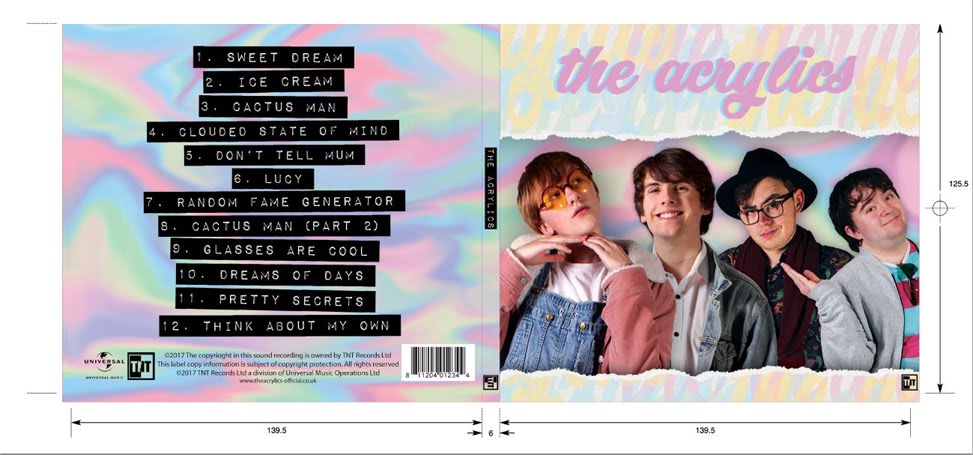
Exterior.
Interior.
It consists of a focal image of each of the band members
descending in size, in order of importance to the band; Casey, Hugh, Guy, then
Terrence. Additionally, there is a simple, hand-drawn background and logo,
conveying our image and branding, whilst also informing the audience of who we
are. The inside panels will have photos of the band member’s being shared over
a table, highlighting the friendship amongst the members of the band, and
providing the audience with some extra content that will engage them in our
band. The back cover is bold lettering (possibly cut out from a magazine/pieces
of paper) over a simple, hand-drawn background. This is easy to read, and
extends the band aesthetic and branding.
Our audeince feedback told us that it was important to have all of our band members shown on the front cover of the digipak, as it gave them a sense of the band. We also found out that the audeince like a visually engagin inside panel that complements the music, which is why we have chosen to go with the covered table inside panel.