Here is my Music Video:

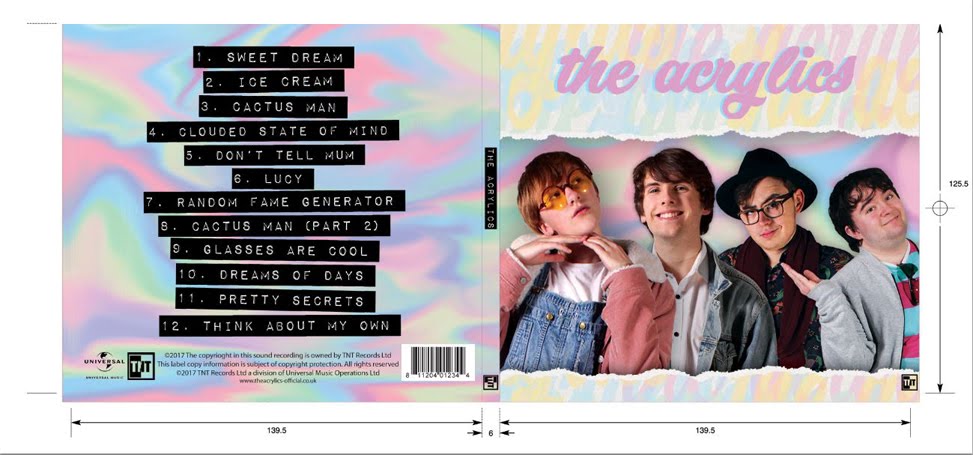
Here is the outside panel for my digipak:

Here is the outside panel for my digipak:

Here is the inside panel of my digipak:

Here is the inside panel of my digipak:

Here is my website:

Here is my website:
Please click the image to follow the link to our website.

Thursday, 14 December 2017

Construction Post 1: Week 1 Production

Our first week of production was our shoot week. During this week we used the school studio to film all the shots we neededd for our music video using the professional standard lighitng desk, sound desk, and cyclorama for a high quality shoot.

CHALLENGES:
  • Organising an ensemble cast for our first day of filming, which took place on Saturday the 4th of November.We had to make sure they all knew what to do in the video, how to act in the school and how to get to places in the school. In order to keep them in the loop with this sort of information, we gave them all a quick briefing at the beginning of the shoot day, meaning that we would have an easy and efficient shoot day ahead of us. It also meant that the cast were aware of health and safety precautions they needed to take while working in the studio. In order to keep their energy levels high, we provided snacks, music, and frequent breaks, ensuring the best performance we could get out of them.
  • Creating an infinity scene using the cyclorama, as there was an obvious dark line where the wall screen met the paper on the floor. We spent Monday morning trying to fix this using sheets of paper to connect the floor and wall screen, but was still obvious on camera, and made the space look more messy. In the end, we decided it would be beneficial for the shoot and the video to leave the cyclorama with the line between the wall and the floor. We felt this was the right thing to do because all the shots we had taken on Saturday were taken in this set up, and we were unable to retake these. Additionally, we felt that as we were creating and indie and home-made-style music video, the line between the wall and the floor would match the aesthetic of our video. This sort of set-up has been used in other indie videos that have a similar aesthetic to our own, such as Vampire Weekend's A-Punk.
  • Our worst challenge that we had to face happened on the Thursday of our shoot week. We scheduled in a slot of looking back on our footage and checking if we needed to use our back-up shoot slots to fix anything. Unfortunately, we discovered that the footage from Tuesday, our most productive shoot day, was corrupted, and it hadn't transferred to the iMac properly when dumping it. This meant that we had to re-shoot our shots form the Alice in Wonderland and Singin in the Rain shots. Luckily, we had both Friday and Saturday scheduled for back-up shoots, so we had enough time to re-shoot all the footage that was corrupted, although it was a shame to have to re-shoot it. Additionally, all the footage we took after that realisation, we dumped twice and checked the footage thoroughly after dumping it.
Vampire Weekend - A-Punk. This is an indie music video that has a similar home-made aesthetic as our own, and also has an obvious difference between the wall and the floor.

Our audeince feedback showed that this would not be a problem, and many of our audeince members said they wouldn't noticce this with all the other mise-en-scene going on in the video (such as the hand-made props).

Our teachers also did not think this was a problem, as we showed them many other music videos that also have this, and how they have used that lo-fi setting to appeal to their audience.

MY CONTRIBUTION TO THE SHOOT:
  • I played the main character int the video, so did the lip-syncing during band and solo shots, as well as acting as Casey and Casey as Alice.
  • I filmed many of the shots in the scenes I was not in, such as Emilio's solo performance shots and Jack's solo performance shots.
  • I helped to create some of the set-ups, such as the Mortal Kombat set up and the Singin in the Rain set up. This involved using the light desk in order to change the colour and intensity of some of the studio lights in order to get the right feel of the shot.
Here is a slide show explaining some of the ways I helped on set.

Sunday, 5 November 2017

R+P Post 33: Reflections on my role and contribution during research and planning

I contributed a lot of work to this project, as did Jack and Emilio.

PRE-PRODUCTION:
  • Helped to make the props, such as the slot machine.
  • Gave lots of influential research examples for our website, album cover, and music video. For example, I gave the example of Alvvays's website as one that has a similar aesthetic to the one we hope to achieve.
  • Helped in getting people together for the Saturday shoot with an ensemble cast.
  • Helped to come up with ideas or a music video int he very beginning of the project.
  • Came up with some good tracks when deciding our track of choice.
  • Contributed ideas towards the shot list and set-up list.
  • Helped to create flat plans for the digipak panels and for the website.
PRODUCTION:
  • Performed as the lead singer of the band.
  • Helped with creating the lighting set ups and filming the actual shots.
  • Took photos of the other members of the band during the promo shoot.

R+P Post 32: Test shoot and rough edit

We did a test shoot in order to test how our ideas, lighting set-up, and shot framing would work on camera before the real shoot. This meant that if we needed to change anything,we had the time to and it wouldn't waste time on the real shoot. Additionally, it meant we could test how our performances looked on camera.

The test shoot revealed things we needed to change about our set-ups. For example, the Singin in the Rain lighting set-up had really nice lighting in real life, but on camera it made our faces too dark, and did not show the lights from the lamppost well enough. We then changed the lighting to a mix of white, yellow, and red lights so that we could light up the centre stage, but still achieve the colour we wanted.

Me checking the lighting on the Koolertron monitor.
Me checking my performance in between taking shots.


Jack coaching me with performance to make sure I get the look and feel of the character right for the video.

One of the things that did work on our test shoot was our band's performance. the test shoot showed that our performance worked on camera with the light pink lighting and the different framing, and that our performances looked accurate. Also, the fun relationship between all the band members really worked on camera, and we were good at making our sibling relationship look fun and silly.

Here is one of our test shoot band shots, complete with costumes, props, and lighting.

R+P Post 31: My call sheet

We combined our call list with our shoot board, as it was easier to see who was needed, when and why. For example, we could see what shot we were doing at a certain time and then quickly and easily reference the call sheet to find out who was needed.

Page 1 of our shoot board, which includes the call sheet. See "R+P Post 20: My shoot board" for the full shoot board and call sheet.
WHY A CALL SHEET IS IMPORTANT:

We can tell other people in advance when they need to be in the studio and what they need to do. For example, Tom is not in our media group, so we gave him a copy of the call sheet so that we could ensure he would be in the studio when we needed him. Additionally, we used Lily as our make-up artist, and she also doesn't do media A2, so we gave her a copy so that she would know where to be and when, and what make-up she needed to bring.

R+P Post 30: My shoot-board

We created a shoot board so that we could stay organised on the shoot, and to make sure that we wouldn't miss any shots that we had planned to take.

We created our shoot board set-up by set-up, as well as based on the times our actors and make-up artist were available. This meant we needed to include our call time for all the people who needed to be there.


Here is a presentation of our shoot board pages in order.

PROS OF MAKING A SHOOT BOARD:
  • Helps us to stay organised on the shoot.
  • Ensures that we take all of the shots that we need in the amount of time we have.
  • Allows us to set up the studio in advance and tell people when they need to be there.

R+P Post 29: Rehearsals

We decided that we should do rehearsals for some of our shots because some of the scenes involved dances and movement sequences that were complicated for us to do considering none of us have any dancing experience. The biggest challenge was choreographing the movements for Singin in the Rain and Mortal Kombat. The dances for Singin in the Rain were difficult because we needed to keep the framing tight while also doing big dances with umbrellas around a lamp post. This meant that we often went off frame even when we did get the movements right. Additionally, it was difficult to use the umbrellas gracefully in the dances, so we really had t practise that. The Mortal Kombat movements were quite difficult to get nicely on frame, as the power bars were difficult for jack and Lily (our make-up artist) to manoeuvre smoothly, and to keep their bodies off frame. We also rehearsed the fight sequence Emilio and I were to do so that it would be clear in the narrative for the audience and also look smooth on camera.

Emilio and I rehearsing our fight scene during the test shoot.

BENEFITS OF REHEARSING: 

  • Saved us lots of time in the actual shoot, as we already knew what we had to do and how.
  • Got us performance-ready, so that we were used to our characters and how to act as a part of a band.
  • Allowed us to make sure that our dances looked neat and professional.

R+P Post 28: My kit list

For our shoot, we were lucky enough to have access to our school's professional standard equipment, including a Canon 5D camera, which enabled us to produce high quality footage, taking in the detail of all the lighting, costumes, props beautifully. It also had a manual focus lens, which allowed us to tamper with the depth of focus, and allowed us to get really nice crisp shots.

The lighting desk was really useful because it allowed us to create full-colour lighting set-ups with different colour mixes and light intensities depending on the scenes. For example, for the Singin in the Rain shots we used  mix of yellow and red lighting at a low intensity so that the camera could pick up the lights on the lamppost as well as having our faces well-lit.

The sound desk was also a very useful piece of kit because it allowed us to play the song while performing, which helped with our performance standard and definitely with my lip-syncing.  Also, it meant that when we were setting up and packing away the kit, we could listen to music on the speakers.

The Samsung TV monitor and the Koolertron monitor were both incredibly useful as well. The Koolertron monitor made it really easy to see the screen and test how the lighting set-ups looked like on the camera, as the built in digital screen on the camera was too small to be able to accurately focus and see the footage quality. The Samsung TV monitor was useful because we could see it when we were performing, helping us to stay in frame when and make sue our performance was up to standard, and it also meant that when creating the lighting set-up, we could see how the colours looked on screen from the lighting desk (although it is not as accurate as the Koolertron monitor in terms of colour).

Our kit list.